


Author: Bob Grace: Founder, President and Managing Director, Sustainable Energy Advantage
Estimated reading time: 13 minutes
State clean energy procurements play a central role in translating policy goals into actual infrastructure. They determine which projects move forward, which resources are added to the system, and how clean energy targets take shape in practice. These decisions influence not only progress toward climate and energy objectives, but also the effectiveness of broader clean energy policies and the credibility of the commitments behind them. Because these decisions are shaped by how bids are evaluated, the analytical frameworks used to evaluate bids matter as much as the bids themselves.
In several recent Northeast state clean energy procurements, outcomes have diverged from articulated targets, with awards falling short of stated volumes or, in some cases, resulting in few or no selections. In a number of instances, the explicit or implicit conclusion has been that the bids received were too costly under the applicable evaluation framework. While not suggesting that any particular procurement made the wrong call, when results diverge from expectations, it’s worth examining not only the bids themselves, but also the structure of the evaluation process — including the assumptions against which those bids are compared.
In state clean energy procurements offering long-term contracts or incentive payments, bids are evaluated not only against one another, but also against an assumed alternative — a representation of what costs and system outcomes would look like if no contract were awarded and the system evolved under a “business-as-usual” path. In many recent Northeast procurements, quantitative metrics, primarily price and related measures such as net-over-market cost, benefit-cost ratios, or ratepayer impact calculations, account for roughly 70 to 75 percent of the total evaluation weight. Because those metrics are calculated relative to the assumed alternative, the structure and content of that benchmark can materially influence not only which projects are selected, but whether and how much capacity is procured at all.
During the last couple of years, procurement decision makers have been operating in an environment marked by elevated uncertainty. The energy sector has seen significant increases and/or volatility in interest rates, trade policy, and interconnection costs. Supply chain constraints, which could prove temporary, are elevating equipment and services costs. At the same time, key federal incentives that materially affect project economics are being phased out, with qualification thresholds and associated risks continuing to evolve. In this context, officials must decide whether contracting for the next incremental project now is prudent, or whether current bid prices reflect conditions that may shift before projects come online.
Developers, for their part, incorporate these realities directly into their bids. Proposed projects must secure financing, post security, and withstand investor scrutiny. Lenders and equity providers stress-test assumptions about capital costs, construction risk, supply availability, and market revenues before committing capital. In short, real projects are disciplined by prevailing market conditions. Crafting the assumptions used to evaluate those bids is therefore especially challenging: evaluators must make judgments under the same uncertainty without the discipline of capital at risk or the ability to observe the alternative future those assumptions represent.
If the first post in this series (Compared to What - Part 1) asked “Compared to what?”, this one asks a companion question: Compared using which assumptions — and are they appropriate for the place, time, and context in which the decision is being made?
This dynamic raises a foundational question: what assumptions form the benchmark against which bids are evaluated? In procurement analysis, that benchmark is often referred to as the “counterfactual”. Because outcomes hinge on comparisons to that assumed alternative future, understanding how it is constructed, and what judgments it embeds, is central to making well-grounded procurement decisions.
What Is a Counterfactual?
In energy policy and procurement analysis, a counterfactual is a modeled “what-if” scenario. It represents how the energy system is assumed to evolve if the proposed action, such as awarding a contract or procuring a resource, does not occur. Counterfactuals are often described as baseline, reference, or business-as-usual scenarios.
Counterfactuals serve as the benchmark for evaluating projected costs, benefits, and impacts. By comparing the expected outcomes of a proposed project to this assumed alternative future, decisionmakers estimate measures such as ratepayer impacts, benefit-cost ratios, or net market value. The comparison is central: it determines whether a project appears to add value relative to what would otherwise happen.
By definition, a counterfactual is not observable. It reflects assumptions about future costs, resource availability, system configurations, and policy conditions that cannot be directly verified. Constructing one therefore requires judgment. Good counterfactuals strive to be internally consistent, realistic, and comparable to the projects being evaluated, so that decisionmakers can assess tradeoffs on an apples-to-apples basis.
Good counterfactuals strive to be internally consistent, realistic, and comparable to the projects being evaluated, so that decisionmakers can assess tradeoffs on an apples-to-apples basis.
Because a counterfactual cannot be observed, clarity and transparency about its assumptions are critical. The more consequential the procurement decision, the more important it is that the alternative scenario used for comparison reflects current market conditions, plausible system evolution, and the same categories of cost and constraint faced by real projects.
Four Dimensions Where Counterfactual Assumptions Can Drift from Real-World Conditions
Counterfactual assumptions are necessary to evaluate bids, but they are built on modeling choices and data inputs that require judgment. In reviewing recent procurements, I have observed three recurring patterns where counterfactual assumptions can diverge from the conditions faced by real projects, along with one policy design feature that may also shape outcomes in some recent Northeast procurements. These divergences often arise from modeling simplifications, reliance on legacy or generic datasets, or the practical difficulty of keeping assumptions fully current in a rapidly evolving market. When counterfactuals diverge from real development conditions, they can influence perceived affordability and procurement outcomes in material ways. Four dimensions are particularly worth examining.
When counterfactuals diverge from real development conditions, they can influence perceived affordability and procurement outcomes in material ways.
1. Generic or Incomplete Cost Representation
One common source of divergence arises when counterfactual cost assumptions rely on generic or incomplete representations of project costs. Public datasets and standardized model inputs, while useful and often well-researched, are typically designed to provide broad benchmarks. They may reflect national averages, stylized project configurations, or simplified cost categories intended for comparability across technologies.
Real bids, by contrast, must reflect financeable project structures. They incorporate development costs, interconnection studies and upgrades, site-specific mitigation measures, transaction expenses, and the financial reserves or credit support required to secure contracts and financing. Lenders and investors often require contingency budgets, debt service reserves, or other protections that become embedded in bid pricing. If the benchmark used for comparison excludes categories of cost that financeable projects must carry — or assumes simplified project structures that do not reflect how projects are actually capitalized and delivered — the comparison may not be fully apples-to-apples.
Simplifying assumptions also sometimes treat resources as available at a uniform cost. It is common to represent technologies such as wind or solar as “standard units” available at representative scale, cost and capacity factor. In practice, resource development follows an upward-sloping supply curve.
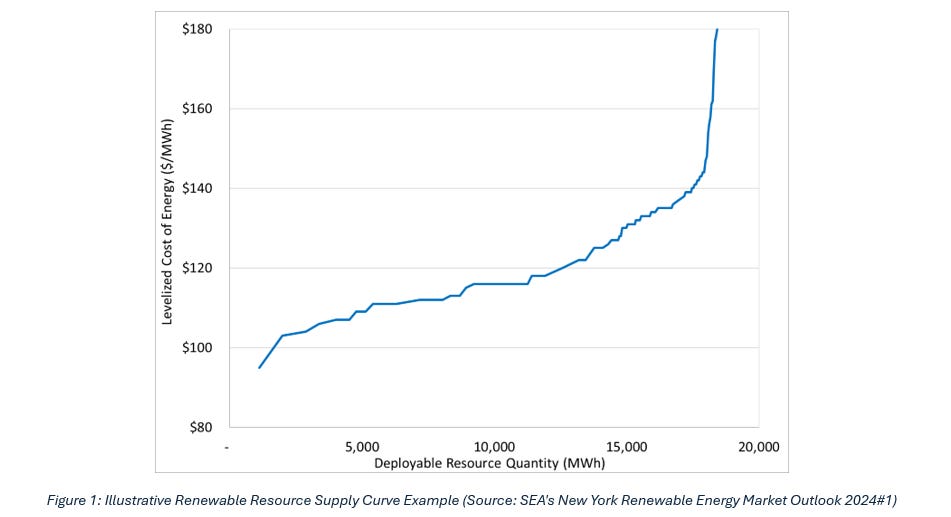
The most economically attractive sites tend to be developed first. As deployment progresses, remaining sites may involve higher land preparation costs, more complex permitting, longer interconnection distances, or additional mitigation requirements. If the counterfactual assumes a relatively flat cost structure while real projects reflect marginal, site-specific conditions, the resulting comparison may understate the true cost of procuring replacement resources.
The issue here is not that generic datasets are inappropriate; they are often necessary starting points. The risk arises when the level of cost completeness and financeability embedded in actual bids is not mirrored in the benchmark used to evaluate them.
2. Geographic Misalignment

A second dimension of potential divergence involves geographic alignment. Energy systems are regional, and cost structures vary materially by location. In higher-cost regions such as the Northeast, construction labor rates, site development costs, permitting requirements, and tax structures, including property taxes, PILOT arrangements, sales taxes, and other state- or locality-specific obligations, can differ significantly from national averages. Some states also operate under union labor frameworks or prevailing wage standards that materially affect project economics.
Interconnection costs and timelines are likewise highly location-specific. Queue congestion, required network upgrades, and the availability of suitable substations can vary widely across markets. Real projects must incorporate these localized constraints into their bids.
Procurements themselves may impose additional region-specific requirements. Bidding resources are often evaluated not only on price but also on commitments to local economic development, workforce training programs, supply chain investments, environmental justice initiatives, or other public interest criteria. These policy objectives may be entirely appropriate; the question is whether the counterfactual carries equivalent burdens, or instead implicitly assumes resources that are not subject to the same regional obligations.
Another question is whether modeled alternatives are grounded by the same geographic constraints on resource availability and development maturity faced by real projects. A counterfactual may assume that additional resources are available at a given cost within a region. In practice, developable sites may be limited by land use constraints, permitting timelines, local labor availability, equipment lead times, or the maturity of projects in the development pipeline.
3. Obsolete or Insufficiently Updated Assumptions
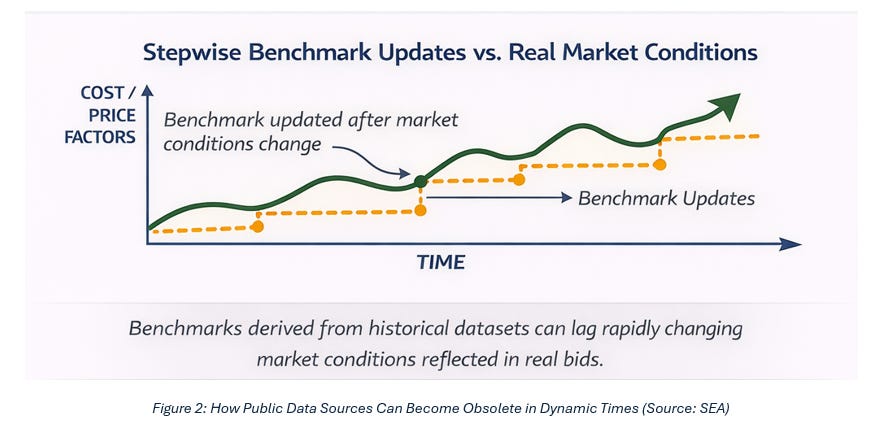
Divergence also emerges when counterfactual assumptions lag current market conditions. Many commonly used cost benchmarks and modeling inputs are developed on periodic update cycles and rely on historical surveys or prior-year data. In stable environments, this approach may be sufficient. In periods of rapid change, however, even well-constructed datasets can become lagging indicators. The timing of when assumptions were developed, and whether they were refreshed prior to evaluation, can materially affect comparisons.
Recent years have seen significant increases and volatility in interest rates, input commodity prices, labor costs, equipment lead times, and trade-related costs. Federal incentives are also being phased down, with evolving qualification thresholds and compliance requirements that affect project economics. Whether the counterfactual benchmark has incorporated comparable adjustments, and whether those adjustments are applied consistently across technologies, is therefore important for a meaningful comparison.
This issue can be particularly salient when different resource types have different recent procurement histories. In regions where renewable resources have been solicited frequently, recent bids provide visible evidence of cost pressures. Meanwhile, alternative resources may lack similar cost discovery, making it difficult for a comparison that reflects current cost conditions equally across technologies.
The challenge is not that assumptions are constructed under uncertainty; that is unavoidable. Rather, in volatile periods, even reasonable benchmarks can drift out of alignment with the conditions reflected in real bids. Regularly revisiting and stress-testing counterfactual inputs helps ensure that procurement decisions rest on contemporaneous and comparable foundations.
4. Policy-Imposed Price Caps and Benchmark Constraints
The last dimension of potential divergence lies in policy design itself. In many Renewable Portfolio Standard (RPS) frameworks, the Alternative Compliance Payment (ACP) establishes the maximum per-megawatt-hour alternative payment that load-serving entities may make in lieu of procuring eligible renewable energy credits (RECs). In theory, the ACP functions as a price ceiling within a market-based compliance mechanism.
In some procurement contexts, evaluators may treat the applicable ACP, either explicitly or implicitly, as a screening benchmark. If the implied or calculated REC price associated with a bid exceeds the ACP, the bid may be viewed as uneconomic or ineligible for selection. Not all procurements are structured this way. But where such a linkage exists, the ACP can become more than a compliance backstop; it can function as a binding constraint in procurement decisions.
In recent years, several Northeast states have reduced ACP levels, often citing ratepayer protection or affordability considerations. The intent may be to limit exposure to high compliance costs. At the same time, broader market conditions have increased the cost of entry for new renewable resources. When these dynamics intersect, the REC revenue required to finance new renewable supply may exceed the prevailing ACP.
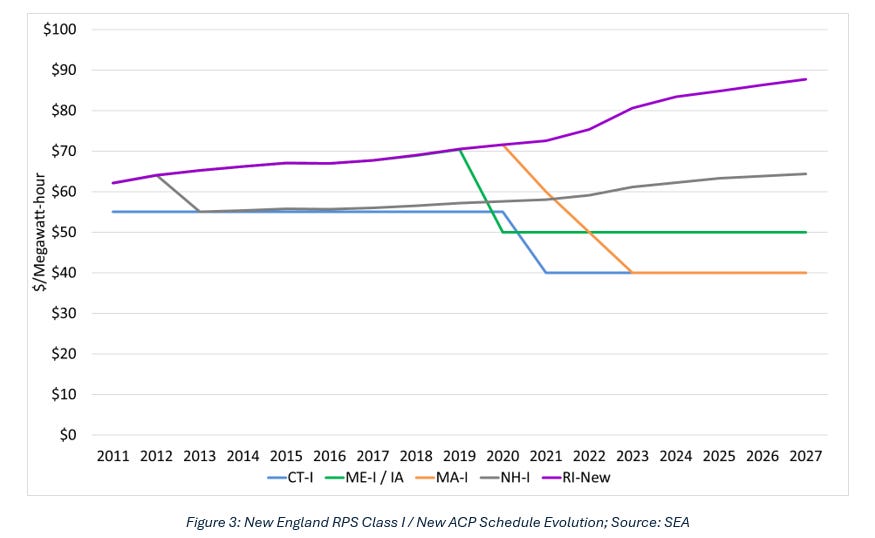
RPS programs are structured as market mechanisms. Like other markets with administrative price caps, the cap must be calibrated to allow sufficient revenue for financeable entry, particularly for the “missing money” not recovered through energy or other revenue streams. If an ACP is set below the cost of entry and bids above that level are effectively precluded, the ACP benchmark may no longer represent a realistic alternative. In that circumstance, the policy-imposed price ceilings start to function as the counterfactual in procurement evaluation.
A deeper examination of ACP design principles, including objectives, calibration methods, and potential unintended consequences, will be explored in a forthcoming installment of The REC Whisperer series. That discussion will take a closer look at how ACP levels interact with market entry, ratepayer protection goals, long-term supply adequacy, and incentives for developers to invest at-risk capital in building a viable project pipeline.
Why These Dimensions Matter
Each of these dimensions — generic cost representation, geographic alignment, temporal relevance, and policy-imposed constraints — reflects a different way in which the benchmark used to evaluate bids can drift from real-world conditions. None is inherently improper. Counterfactuals must be constructed, and simplifications are unavoidable. But when multiple assumptions move in the same direction, they can materially influence which projects clear and which do not.
The central point is not that procurements should accept higher prices, nor that policy safeguards should be relaxed. It is that comparisons should be disciplined, transparent, and grounded in the same categories of cost, constraint, and timing that shape real projects. When bids are evaluated against assumptions that do not reflect financeable, regionally appropriate, and contemporaneous conditions, the outcome may say as much about the structure of the benchmark as about the bids themselves. Precision is valuable, but clarity about assumptions — and symmetry in how they are applied — matters even more.
Improving clarity around those assumptions does not eliminate tradeoffs. It makes them visible — and therefore better suited to informed decision-making.
If this perspective resonates, subscribe to SEA-Scape to continue the Achieving Climate + Affordability series and the broader conversation about how clearer thinking can support better, more durable decisions.