
Getting Real About Advanced Nuclear (Part 1)
Assumptions, expectations—and what it will take to get this right.

Author: Bob Grace: Founder, President and Managing Director, Sustainable Energy Advantage, LLC
Estimated reading time: 9 minutes
How things can change in a hurry. Until the recent completion of the Southern Company-owned Vogtle Units 3 and 4the United States had not brought a new nuclear reactor design into commercial operation for decades.1 For a range of reasons, including cost, public acceptance, safety, and lack of a long-term waste solution, and the availability of increasingly cost-competitive natural gas and renewable energy generation technologies, nuclear’s role in the evolution of the U.S. power system stagnated.
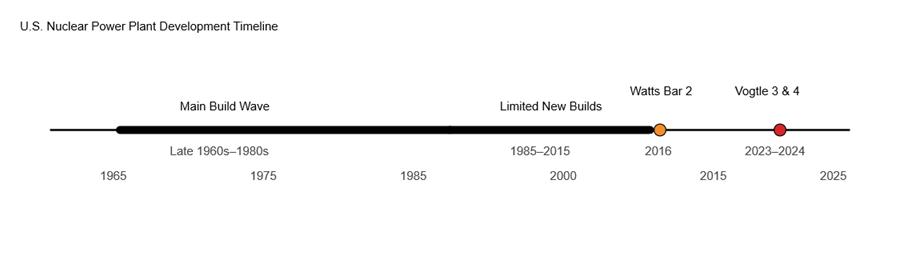
Figure 1: U.S. nuclear power plant development timeline. The U.S. nuclear fleet was largely built in a concentrated wave between the late 1960s and 1980s, followed by decades of minimal new construction. Watts Bar Unit 2 (2016) and Vogtle Units 3 and 4 (2023–2024) represent the only new reactor additions in recent decades.
Sources: U.S. Energy Information Administration (EIA), U.S. Nuclear Industry Overview; U.S. Nuclear Regulatory Commission (NRC), Operating Reactor Licensing Data.
However, broad interest in nuclear power is back. The challenges at the intersection of climate change, affordability, reliability, and load growth are intensifying—and nuclear is increasingly being put forward as part of the solution. In many ways, this renewed focus is warranted. It is difficult to see a durable path forward without at least seriously considering a growing role for nuclear energy.2
I’ve spent most of my career focused on renewable energy—how to scale it, how to make it work in real markets, and how to design policies and procurements that actually deliver results. Earlier in my career, I also worked in power supply functions for utilities with nuclear generation, giving me direct exposure to nuclear economics and its role within a broader power portfolio. That perspective is exactly why I believe nuclear energy deserves serious consideration—and why I’m paying close attention to how it is being discussed right now.
It is also why I am concerned about how it is currently being discussed. A growing body of studies, legislative proposals, and policy signals is placing significant weight on advanced nuclear—often without clearly stating or rigorously testing key assumptions about cost, timing, and feasibility, or grounding those assumptions in how projects are actually developed, financed, and built. In some cases, nuclear is positioned as a near-term or lower-cost alternative to renewables and storage without comparable scrutiny—glossing over the uncertainties that will ultimately determine what it can deliver, and when.
This positioning introduces real decision risk. Without clarity on assumptions, uncertainty, and timelines, decisions are less likely to hold up. If nuclear is to be part of the solution, it will be because we are clear-eyed about what it can actually deliver—not what we hope it might.
Welcome to the first of a four-part arc on nuclear energy realism, intended to provide a shared, reality-based foundation for the conversations we should be having, by making assumptions explicit and more clearly assessing what nuclear can actually deliver, when, and at what cost.
Why Nuclear Is Back
The renewed focus on nuclear energy is not happening in a vacuum. It is emerging in response to a set of pressures that are becoming increasingly difficult to ignore—and to address with any single class of solutions.
The path to scaling low greenhouse gas (GHG) electricity is proving to be more challenging than expected. Costs have risen across technologies, driven by inflation, interest rates, supply chain and labor constraints. At the same time, siting and permitting constraints have become more visible—and in many regions, more binding. These challenges are showing up in procurement outcomes, project timelines, and policy implementation.
At the same time, concerns about affordability are growing. As systems evolve toward higher shares of variable renewable energy, maintaining reliable service will require more complex portfolios and coordination. Electrification is increasing baseline demand, while data centers and AI are introducing new, concentrated load growth with stringent reliability requirements. All of this is unfolding alongside ambitious, time-sensitive climate targets.
Taken together, these pressures are driving a search for additional sources of firm, dispatchable, carbon-free generation that can complement renewable energy and provide reliability in increasingly complex systems.
Advanced nuclear energy fits that description.
It is therefore not surprising that attention has pivoted in this direction. In many cases, that shift reflects a growing recognition that renewable energy and storage alone may not be sufficient under real-world constraints to develop a reliable and affordable low-GHG power system at scale.
But this shift toward advanced nuclear is happening alongside substantial unknowns about cost, timing, supply chains, and execution, and with development timelines that extend well beyond those of most other low-GHG resources.
That combination makes it especially important that the underlying assumptions are clear, grounded, and consistently applied—because if they’re not, we risk building strategies on a foundation that won’t hold, without a fallback plan.
Where the Conversation Breaks Down
The renewed attention to advanced nuclear energy is understandable. However, the way it is increasingly being discussed warrants closer examination.
A growing share of the studies, policy statements, and broader commentary around advanced nuclear do not clearly articulate, or rigorously interrogate, the assumptions that underpin conclusions about cost, timing, and feasibility. In some cases, advanced nuclear is positioned as a near-term or lower-cost alternative to other resources without fully examining the feasibility or validity of the implicit assumptions, the conditions required for that outcome, or the risks that could prevent it from being realized.
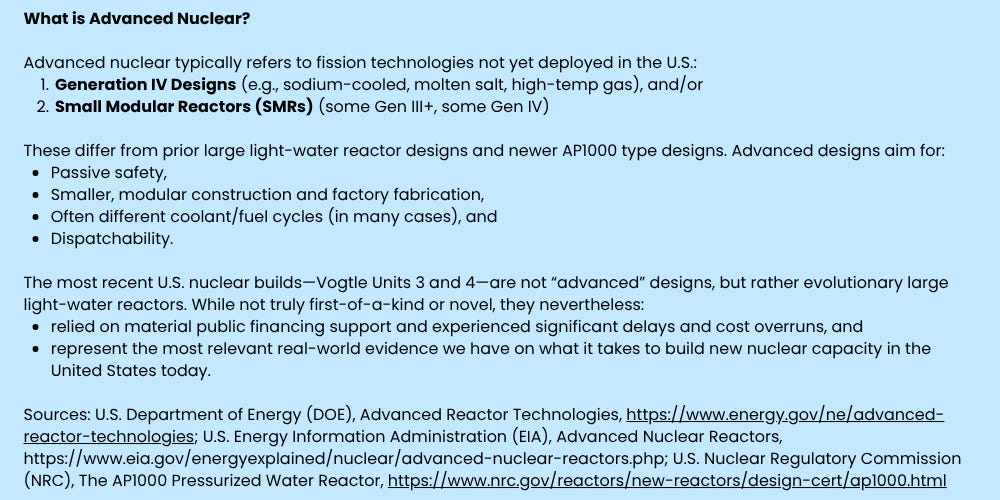
Some of this reflects a lack of experience commensurate with new technology. With no U.S. advanced nuclear commercial deployment experience, and the limited nuclear deployment activity for decades, the following dynamics are showing up:
Technologies already being deployed at scale are often assessed based on observed project outcomes and current market conditions. In contrast, analysis and discussion about advanced nuclear’s future role are necessarily more forward-looking and dependent on assumptions that have not yet been validated in practice.3 That makes clarity and consistency in how those assumptions are framed especially important.
Many policymakers, legislators, stakeholders, and members of the press have limited exposure to how these projects are actually developed, financed, and delivered—or the specific risks and hurdles that can prevent successful deployment or lead to significant cost overruns. This creates a challenge for those who may not have the background to fully interrogate those assumptions.
While discussions among investors, developers, utilities, and system planners are often grounded in project-level realities, system constraints, and financing consideration, broader public, political, and media discourse can sometimes rely on less-tested or implicit assumptions or simplified narratives, or are framed in ways that (intentionally or not) tilt toward more favorable outcomes. As these perspectives increasingly shape policy direction, the distinction becomes consequential.
This dynamic is increasingly visible in public discourse. In one recent example, a state legislator argued that support for “undependable technologies that people cannot afford without subsidies” may need to give way to “new technologies on the horizon, such as advanced nuclear reactors.”4 The issue is not the preference being expressed, but that such statements often rely—implicitly—on two unexamined assumptions: that advanced nuclear will be available on a timeframe relevant to current decisions, and that it will prove more affordable than the resources it is being invoked to replace..
Equally important, much of the current conversation focuses heavily on reactor design, that is, on the potential for safer, smaller, and more modular technologies, while paying less attention to the broader set of conditions that will ultimately determine whether a nuclear resurgence succeeds.
Those conditions extend beyond technology. They include siting and permitting, financing and cost control, supply chain and workforce development, access to cooling water, public acceptance, fuel supply and waste management, and the institutional capacity required to manage these systems over decades. These gating factors define the boundary between what is technically possible and what is realistically achievable, yet they are often less visible in high-level discussion. None of this is to suggest that nuclear cannot succeed. A more rigorous and transparent conversation is not about limiting its role—it is about increasing the likelihood that it succeeds where it is pursued.
Because advanced nuclear projects involve significant capital commitments and long development timelines, the consequences of misaligned assumptions may be more difficult to correct once decisions are made. For that reason, greater clarity about what is assumed, and what will be required to make those assumptions hold, reduce the risk of poor policy, misallocated capital, and a loss of credibility if expectations fail to materialize.
Illuminating Three Key Nuclear Realities
Much of the current disconnect stems from a lack of clarity about a few core realities that will ultimately determine what nuclear can deliver, when, and under what conditions.
What nuclear is likely to cost: There is a tendency to talk about nuclear as if its cost were reasonably well understood—or at least bounded within a narrow range.
In reality, nuclear costs are highly sensitive to capital cost execution, financing conditions, construction timelines, and supply chain performance—factors that are difficult to control in practice. Small changes in these inputs can drive large swings in outcomes.
At the same time, as renewable energy and storage costs have risen, some analyses implicitly pivot toward nuclear without clearly assessing what it is likely to cost under comparable conditions. Yet many of the same drivers—higher interest rates, supply chain constraints, labor availability, and construction risk—are equally, and in some cases more, consequential for nuclear. The issue is not whether nuclear can be cost-competitive, but whether the conditions required for that outcome are clearly defined—and likely to hold.
How Wide is Nuclear Cost Uncertainty?
Follow our next post to see what we learned in researching the most credible sources we could find.
When nuclear could meaningfully contribute: Timing is equally important—and often treated loosely. Nuclear is often discussed as if it can address challenges unfolding over the next decade, but new capacity is unlikely to be available at scale within that timeframe—even under optimistic assumptions. Development timelines are long, and learning curves, supply chains, and workforce capacity do not expand overnight. What matters is not when the first project comes online, but when nuclear can contribute at scale. That distinction is often blurred.
What it will take to make it work: Success is not determined by reactor design alone. Even if next-generation technologies deliver improved safety and modularity, a broader set of conditions must be met for nuclear to be deployed at scale. These include the ability to:
Site projects in viable locations,
Secure permits and financing,
Manage construction risk,
Ensure access to adequate cooling water,
Achieve and sustain public acceptance,
Establish and scale fuel supply chains,
Establish a sustainable long-term waste solution,
Ensure safety and security, and
Sustain the institutional capacity required to oversee these systems over decades.
Each represents a potential constraint, and together they define the gap between what is technically possible and what is realistically achievable. These issues—and their implications—are rarely made explicit in today’s conversation.
What This Arc Will Do
This four-part arc is intended to help close that gap—not by arguing for or against nuclear energy, but by bringing greater clarity to the assumptions, expectations, and conditions that will determine whether it can succeed.
The next two posts examine two of the most consequential—and often misunderstood—dimensions: what nuclear is likely to cost under real-world conditions (Part 2), and when it could meaningfully contribute at scale (Part 3).
The final post (Part 4) will step back to address the broader set of challenges that are often left out of the conversation—but will ultimately determine whether a nuclear resurgence is viable, sustainable, and publicly acceptable.
Conclusion
If nuclear is going to play a meaningful role, it will not be because of what is promised. It will be because of what can actually be delivered—at scale, on time, and at a cost that holds up under real-world conditions. That requires clarity about what we know, what we don’t, and what it will take to close the gap.
The gap between what is assumed and what it will take to materially expand the U.S. nuclear fleet is not theoretical—it shows up in project outcomes, system performance, and the durability of policy decisions. If these realities are not made explicit, expectations can become internally inconsistent - assuming favorable outcomes on cost, timing, and execution without accounting for what it will take to achieve them - raising the risk of decisions that do not hold up under real-world conditions.
If this framing is useful, consider subscribing to SEA-Scape to follow the rest of the series—and sharing it with others who may benefit from a more grounded, constructive discussion.
While the Watts Bar 2 project reached commercial operation in 2016, it is based on a 1970s-era Westinghouse pressurized water reactor (PWR) design. Construction originally began in the 1970s and was suspended for decades, then completed in 2016.
Recent progress in fusion research, including breakthroughs towards achieving sustained fusion reactions that produce more energy than they consume, has renewed interest in its long-term potential. However, as fusion remains decades away from commercial deployment at scale, this series focuses on the next generation of nuclear fission technologies.
It is important to note that challenges in how mature and emerging energy resources are discussed are not unique to nuclear.
Michael Graham, “‘Enough Is Enough:’ House GOP Bill Would Put 20 Year Cap on Green Subsidies,” NH Journal, March 11, 2026, quoting Rep. Michael Vose: “With new technologies on the horizon, such as advanced nuclear reactors, the time for supporting undependable technologies that people cannot afford without subsidies may need to give way to a new generation of energy suppliers.” https://nhjournal.com/enough-is-enough-house-gop-bill-would-put-20-year-cap-on-green-subsidies/
Bob - thanks for a thoughtful and "grown up" piece. As a former nuclear engineer (all the way through the doctoral process), it's been interesting to see another resurgence in interest of 'advanced' nuclear designs that were 20 years old in the mid to late 1980s.
Your article hits the bullseye on an often-underappreciated fact about new energy technologies (and new commodity technologies in general) - it's an incredibly rare technology that emerges from the laboratory that is immediately and widely embraced and deployed, even if the technology is clear superior to what existed before it.
Commercial electricity is a good example - fully supplanting gas lamps, water mills, and all manner of human labor with electricity driven tools took multiple years for a single region of the US, and multiple decades for the entire US. Crucially, that transition required new commercial and regulatory innovations (e.g., a public utility regulatory body that was chartered with regulating electricity companies, sorting out how land could compulsively acquired if needed for a power plant or transmission line, etc.).
Later, the development of technical feasible renewables that needed some policy support elicited the same need for commercial and regulatory innovations - RPSs, regulatory-approved resource plans that included renewable mandates, state and federal tax and production incentives, etc. All of these non-technical innovations contributed to building the order book for renewables, which in turn drove down their costs.
Advanced nuclear will be no different. Commercial and regulatory innovations (e.g., finally developing an implementable long-term waste disposal process, or supporting supply chains for high assay, low enriched uranium) will be necessary if advanced (or conventional) nuclear is to meaningfully contribute to a clean energy grid worldwide.
You correctly point out that designing those commercial and regulatory innovations will take time and effort, and should only be pursued if a clear-eyed view of *everything* that is required to get nuclear to "work for us" concludes that the time, money and political capital to be spent is worthwhile.
All too often, new technologies clamor for policy support too early, and with optimistic (perhaps wildly so) projections of technical advances and cost reductions. For example, my personal opinion is that data center demand for AI is fueled by an optimism that may be justified ultimately, but seems a bit premature (except perhaps in the area of writing code). Just as we don't need dozens (if not hundreds) of data centers that fall silent in 10 years, we should match the pace of investments in any nascent energy technology (green cement and steel, advanced nuclear, etc.) to the pace of realistic understandings of "how much impact, how fast".
Thanks for kicking off the conversation.
Nice piece, Bob. One under-appreciated ironic constraint: nuclear will be competing heavily with the data data centers they are being proposed to serve for very scarce skilled electricians and more, driving up the costs of both, as well as of “electrifying everything.”
“A dire electrician shortage is a ‘life or death’ threat to the AI data center boom…,” https://fortune.com/2026/03/02/ai-data-centers-electrician-shortage-gen-z-training-careers/
“All the nuclear workers are building data centers now,” https://heatmap.news/energy/data-centers-labor